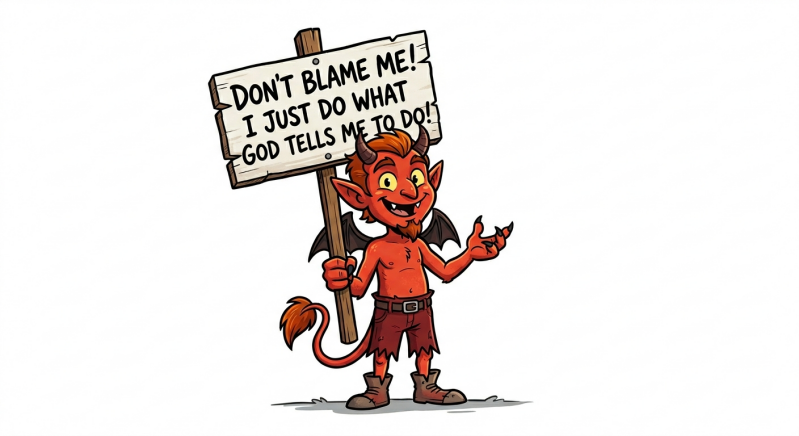
Failed Devil
The common Christian perception of Satan is shaped more by Hollywood than the Bible. Many believers envision him as a formidable adversary to Yahweh and Jesus, filled with hatred for humanity and determined to lead people astray. In this narrative, Satan becomes a convenient scapegoat for Christians who struggle with moral failings and wish to evade personal responsibility. They will often plead, "The devil made me do it!", when caught in a serious sin. Satan bears the blame while believers find solace in the idea that Jesus absolves their sins for eternity. This dynamic creates a total lack of personal accountability within Christianity. Is it any wonder this religion sells so well?
Fail! Satan didn't tell the first lie. God did.
Gen 2:15 The Lord God took the man and put him in the garden of Eden to till it and keep it. 16 And the Lord God commanded the man, “You may freely eat of every tree of the garden, 17 but of the tree of the knowledge of good and evil you shall not eat, for in the day that you eat of it you shall die.”
Gen 3:He said to the woman, “Did God say, ‘You shall not eat from any tree in the garden’?” 2 The woman said to the serpent, “We may eat of the fruit of the trees in the garden, 3 but God said, ‘You shall not eat of the fruit of the tree that is in the middle of the garden, nor shall you touch it, or you shall die.’ ” 4 But the serpent said to the woman, “You will not die, 5 for God knows that when you eat of it your eyes will be opened, and you will be like God, knowing good and evil.”
This isn't complicated. God instructs Adam not to eat from the tree of the knowledge of good and evil, warning that, "in the day that you eat of it you shall die." However, the serpent, often interpreted by Christians as Satan, tells Eve that she will not die but instead gain enlightenment. What transpired? Both Adam and Eve consumed the fruit, acquired knowledge, and continued to live for hundreds of years. To cope with this inconvenient scripture, Christians often claim that Adam and Eve experienced spiritual death that day. However, this interpretation is found nowhere in this text. Moreover, it contradicts the Christian belief that all human souls are immortal.
Fail! Satan can't be evil or he wouldn't be able to stand in Yahweh's/Jesus's presence.
Psalm 5:4 For you are not a God who delights in wickedness; evil will not sojourn with you.
Job 1:6 One day the heavenly beings came to present themselves before the Lord, and the accuser also came among them. 7 The Lord said to the accuser, “Where have you come from?”
Matt 4:14 Then Jesus was led up by the Spirit into the wilderness to be tested by the devil.
The bible claims two important things in the above referenced scripture. First, it asserts that God cannot tolerate evil in his presence. Second, it give two examples of the devil being in God's direct presence. This shouldn't be possible if the Psalm is telling the truth.
Fail! Only an evil father would turn a psychopath loose on his children.
If Christians are to be believed, and Satan is a powerful supernatural evil force hell bent on the destruction of mankind, why would God unleash him on us? The common Christian response to this obvious dilemma is that Satan is required for us to have free will. Ridiculous! If anything, a devil whispering in your ear does far more to remove your free will than support it. Will there be free will in heaven? If so, how is that possible without a devil also being there? Maybe Christians are hoping to be mindless slaves in eternity.
According to the narrative, after the fall, God cursed the world, leading to mankind's ongoing struggles with mortality. Starvation, disease, and natural disasters became our fate, consequences of our disobedience to Yahweh. Apparently, this punishment was insufficient, as He also unleashed Satan to tempt and deceive us, driving us further into sin and risking the loss of our eternal souls. If this account holds true, it raises a troubling question: Is God powerless to intervene, or is he evil?
Fail! God, not Satan, is responsible for Job's suffering.
Job 1:One day the heavenly beings came to present themselves before the Lord, and the accuser also came among them. 7 The Lord said to the accuser, “Where have you come from?” The accuser answered the Lord, “From going to and fro on the earth and from walking up and down on it.” 8 The Lord said to the accuser, “Have you considered my servant Job? There is no one like him on the earth, a blameless and upright man who fears God and turns away from evil.” 9 Then the accuser answered the Lord, “Does Job fear God for nothing? 10 Have you not put a fence around him and his house and all that he has, on every side? You have blessed the work of his hands, and his possessions have increased in the land. 11 But stretch out your hand now, and touch all that he has, and he will curse you to your face.” 12 The Lord said to the accuser, “Very well, all that he has is in your power; only do not stretch out your hand against him!” So the accuser went out from the presence of the Lord. 13 One day when his sons and daughters were eating and drinking wine in the eldest brother’s house, 14 a messenger came to Job and said, “The oxen were plowing and the donkeys were feeding beside them, 15 and the Sabeans fell on them and carried them off and killed the servants with the edge of the sword; I alone have escaped to tell you.” 16 While he was still speaking, another came and said, “The fire of God fell from heaven and burned up the sheep and the servants and consumed them
The book of Job is a massive thorn in the side of Christianity for good reason. First, it makes clear that Satan has no power to harm humans unless God gives him permission. Second, it demonstrates Yahweh's willingness to brutally kill humans on a whim or to settle a bet. Third, it shows that God refuses to be accountable and will get angry if people ask why all their suffering is occurring. Welcome to your divine slave master, Christians!
Fail! The mythology of Satan has changed over time.
The term "Satan" originates from Hebrew, meaning adversary or accuser. Ancient Jews did not subscribe to the belief that God created an evil being to stand against Him. Instead, Satan's role was to highlight the spiritual shortcomings of the Jewish people—nothing more.
In the New Testament, however, Satan evolved into a more complex figure, largely due to Greek influences that introduced the concept of opposing supernatural forces of good and evil. During the early church period, Zoroastrianism, with its dualistic perspective on a cosmic struggle between good and evil, was also prevalent. Therefore, it is not surprising that Satan adopted a new identity within Christianity.
Below are some links that delve into this fascinating aspect of Christian mythology.
https://www.youtube.com/watch?v=wc47JDmpWt0
https://www.youtube.com/watch?v=1qoTG2K2GGg
https://www.youtube.com/watch?v=tQNZtajqKNM&list=PLlvD9fXgpCNzylN2wj-RxnVDsHMfCrfo_
Create Your Own Website With Webador